
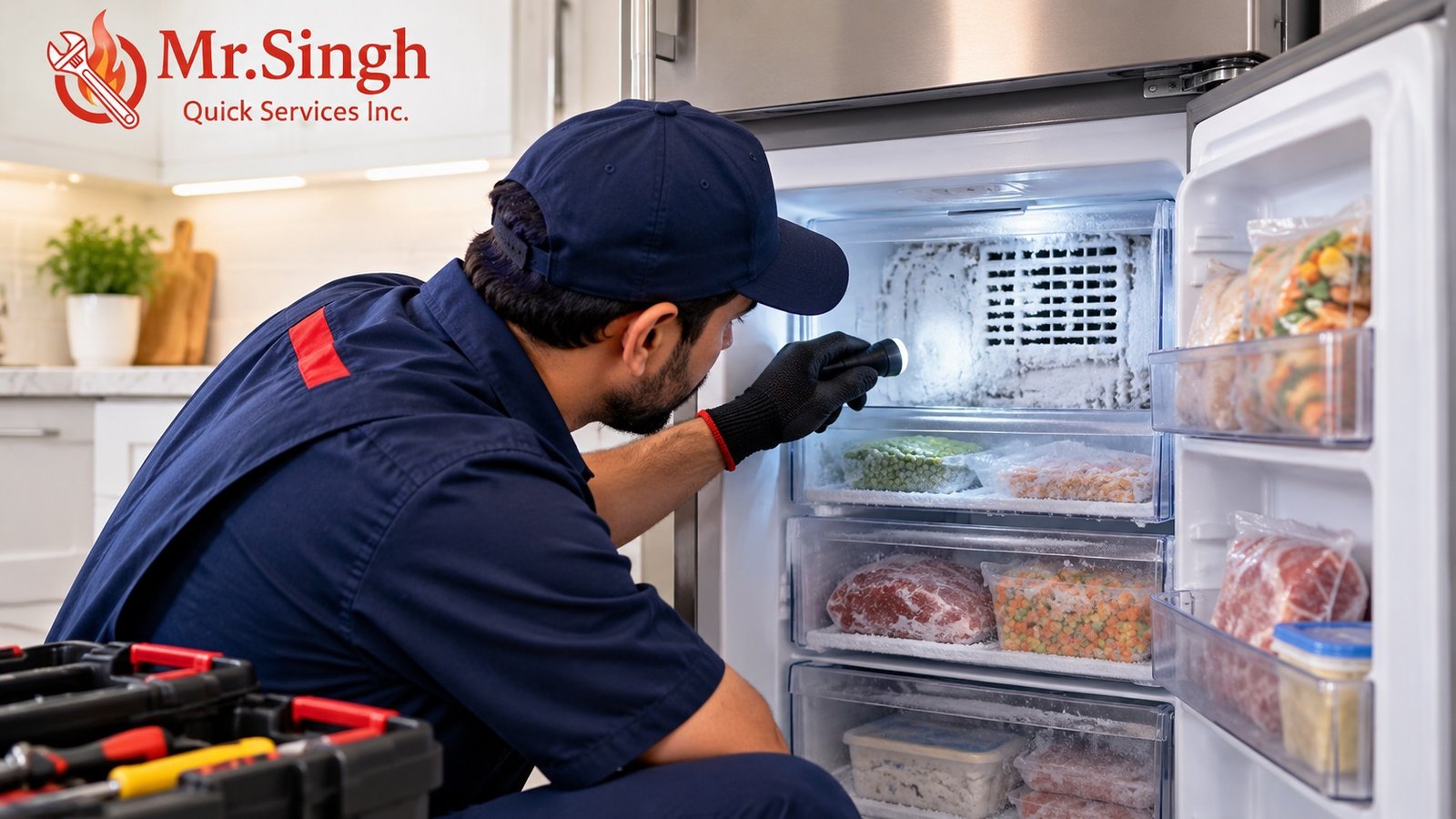
Freezer Not Freezing LaSalle: Professional Freezer Repair Services
Is your freezer no longer keeping food properly frozen? Have you noticed soft ice cream, partially thawed meat, or frozen vegetables beginning to lose their firmness? A freezer that stops maintaining the correct temperature can put food quality at risk and disrupt your household routine.
For homeowners searching for freezer repair in LaSalle, Ontario, understanding why the appliance is not freezing properly is the first step toward finding the right solution.
A freezer may stop freezing because of dirty condenser coils, a faulty evaporator fan, damaged door seals, a malfunctioning thermostat, or a problem with the compressor or defrost system. Some issues can be identified through basic checks, while others require professional diagnosis.
Mr.Singh Quick Services Inc. helps customers looking for appliance repair solutions understand common freezer problems and explore appropriate repair options.
Need help with a freezer that is not freezing? Call +1 519-919-3195 to discuss your appliance problem and ask about service availability in LaSalle.
Why Is Your Freezer Not Freezing Properly?
A freezer depends on several components working together to remove heat and maintain a consistently low temperature. When one of these components fails or airflow becomes restricted, the freezer may struggle to keep food frozen.
Here are some common causes to consider.
1. Dirty Condenser Coils
Condenser coils help release heat removed from inside the freezer. When dust and debris accumulate on accessible coils, heat transfer can become less efficient.
As a result, the appliance may run longer than usual while struggling to maintain the desired temperature.
Common warning signs include:
- The freezer runs for extended periods.
- Food becomes softer than usual.
- The appliance feels unusually warm around certain exterior areas.
- Cooling performance gradually declines.
What you can do: If your model has user-accessible condenser coils, follow the manufacturer's instructions for safely cleaning them. Disconnect power before performing permitted maintenance and avoid damaging the coils or nearby wiring.
If the freezer still cannot maintain its temperature, a technician can investigate other possible causes.
2. Faulty Evaporator Fan
The evaporator fan circulates cold air through the freezer compartment. If the fan motor fails or airflow becomes obstructed, some areas may remain cold while others become too warm.
You may notice uneven freezing, soft food, or unusual fan noises.
A technician can inspect the fan, check for obstructions, and determine whether the motor or another airflow component requires attention.
3. Damaged Freezer Door Seal
The door gasket creates a seal that helps prevent warm air from entering the freezer. If the gasket becomes torn, loose, dirty, or deformed, warm air can enter the compartment.
This may cause frost buildup, temperature fluctuations, and longer cooling cycles.
Inspect the visible gasket for gaps or damage. Clean it according to the manufacturer's instructions and ensure that packages are not preventing the door from closing completely.
If the gasket no longer seals properly, replacement may be necessary.
4. Incorrect Temperature Settings
Sometimes, a freezer is not freezing properly because its temperature setting has been changed accidentally.
Check the temperature control and compare it with the manufacturer's recommended setting. For many household freezers, 0°F (-18°C) is the recommended target temperature.
After making a suitable adjustment, allow sufficient time for the appliance to stabilize before judging the results.
If the freezer remains too warm, the problem may involve a mechanical or electrical component.
5. Frost Buildup or a Defrost System Problem
Excessive frost on the evaporator can restrict airflow and reduce cooling performance.
This may happen when a defrost heater, defrost sensor, timer, or control system fails. A damaged door seal or frequent door opening can also contribute to frost accumulation.
If you notice heavy frost on the interior back panel or recurring ice buildup, a defrost-system problem may be responsible.
Avoid chipping ice with sharp tools or using open flames to melt it. A qualified technician can inspect the defrost system and identify the underlying fault.
6. Faulty Thermostat or Temperature Sensor
The thermostat or electronic temperature sensor monitors the freezer's temperature and helps regulate cooling.
If the sensor provides inaccurate readings or the control system fails to respond correctly, the freezer may not cool enough or may cycle improperly.
Potential signs include inconsistent temperatures, extended periods without cooling, or unexplained changes in appliance performance.
Professional testing can help determine whether the sensor, thermostat, wiring, or control system needs repair.
7. Compressor or Refrigeration System Problems
The compressor helps circulate refrigerant through the sealed refrigeration system. If the compressor or another major refrigeration component develops a fault, the freezer may lose its ability to maintain sufficiently low temperatures.
Warning signs may include a freezer that stays warm despite running, unusual clicking, or cooling that stops unexpectedly.
These symptoms do not automatically confirm compressor failure. A technician must assess the appliance to distinguish compressor issues from electrical, control, fan, or refrigerant-system problems.
Sealed-system repairs should be performed by appropriately qualified professionals.
8. Overloaded Freezer or Blocked Air Vents
Packing the freezer too tightly can restrict the circulation of cold air. Large quantities of unfrozen food added at once may also temporarily increase the temperature inside the compartment.
Keep air vents clear and follow the manufacturer's loading recommendations. Avoid placing warm food directly into the freezer in quantities that exceed its recommended freezing capacity.
If temperatures do not recover after normal operation resumes, investigate whether another issue is affecting cooling.
Signs You Need Freezer Repair in LaSalle
A freezer that is not freezing correctly may show several warning signs before cooling stops completely.
Look for these symptoms:
- Ice cream becomes soft or partially melted.
- Frozen food begins to thaw.
- The freezer runs continuously without reaching its target temperature.
- Heavy frost develops on interior surfaces.
- The door gasket appears damaged or loose.
- The appliance makes unusual clicking, buzzing, or fan noises.
- Temperature readings fluctuate significantly.
- Food remains soft even after the freezer has been running for several hours.
If food is thawing, move it to a reliably cold appliance or suitable insulated cooler when possible. Do not rely on smell or appearance alone to determine whether thawed food is safe to eat.
Freezer Not Freezing in LaSalle, Ontario: How We Can Help
When your freezer stops maintaining the correct temperature, identifying the cause is essential. A door-seal issue, airflow obstruction, defrost fault, and compressor problem can produce similar symptoms but require different repairs.
Mr.Singh Quick Services Inc. is a contact for customers seeking appliance repair assistance in LaSalle, Ontario.
When discussing your freezer problem, explain whether the appliance is completely warm, cooling inconsistently, developing excessive frost, or making unusual noises. Mention whether the refrigerator compartment is also affected if you own a combined refrigerator-freezer.
A freezer repair assessment may include:
- Checking accessible airflow paths and temperature settings.
- Inspecting the door gasket and signs of warm-air entry.
- Evaluating the evaporator fan and cooling circulation.
- Investigating excessive frost and possible defrost-system faults.
- Checking relevant sensors and electrical controls.
- Assessing symptoms associated with the compressor or sealed refrigeration system.
- Identifying the likely fault and discussing suitable repair options.
The exact inspection and repair process depends on the freezer's make, model, age, and symptoms.
Looking for freezer repair in LaSalle?
Call +1 519-919-3195 to discuss your freezer problem and confirm service availability with Mr.Singh Quick Services Inc.
What Should You Do When Your Freezer Stops Freezing?
Taking sensible steps early can help protect food and provide useful information for troubleshooting.
Step 1: Keep the Door Closed
Avoid repeatedly opening the freezer. Keeping the door closed helps preserve the remaining cold air while you assess the situation.
Step 2: Check the Temperature Setting
Confirm that the temperature control has not been changed accidentally. For many household freezers, the recommended target is 0°F (-18°C).
Step 3: Inspect the Door Seal
Look for visible gaps, dirt, damage, or packages preventing the door from closing fully.
Step 4: Check Air Vents
Make sure stored food is not blocking the internal vents. Follow the manufacturer's recommendations for arranging food inside the freezer.
Step 5: Listen for Unusual Sounds
Note whether the appliance is running, whether the fan seems unusually noisy, or whether you hear repeated clicking. Do not remove internal panels to investigate.
Step 6: Protect Your Food
Keep the freezer closed as much as possible and transfer vulnerable food to a functioning freezer if available. A full freezer generally stays cold longer than a partially filled one during a power interruption, provided the door remains closed.
For food safety, a full unopened freezer typically maintains its temperature for about 48 hours and a half-full freezer for about 24 hours during a power outage, assuming the freezer was operating correctly beforehand.
If perishable food has thawed, follow official food-safety guidance rather than tasting it to check whether it is safe.
Step 7: Arrange Professional Inspection
If the freezer remains too warm, food continues to thaw, or unusual noises and frost buildup persist, contact an appliance repair professional.
How to Prevent Freezer Cooling Problems
Regular maintenance can help your freezer operate efficiently and reduce the risk of avoidable cooling issues.
Keep the door seal in good condition. Inspect the gasket periodically and clean it according to the manufacturer's instructions.
Maintain suitable temperature settings. Follow the manufacturer's recommendations and use an appliance thermometer if you need to verify the actual temperature.
Keep air vents clear. Arrange food so that cold air can circulate properly throughout the compartment.
Clean accessible condenser coils when recommended. Follow the owner's manual and disconnect power before carrying out permitted maintenance.
Avoid excessive overloading. Allow adequate airflow and follow the freezer's recommended freezing capacity.
Investigate heavy frost early. Repeated frost buildup may indicate a door-seal or defrost-system issue.
Respond to unusual noises. Persistent clicking, buzzing, or fan noises can indicate a developing problem that deserves attention.
Is It Worth Repairing a Freezer That Is Not Freezing?
In many cases, a freezer that is not freezing properly can be repaired. The most practical solution depends on the underlying fault, appliance age, parts availability, and estimated repair cost.
A damaged door gasket or certain fan-related problems may be less expensive to address than a major compressor or sealed-system failure.
Before deciding whether to repair or replace your freezer, consider:
- The age and overall condition of the appliance.
- The component responsible for the cooling problem.
- The estimated repair and parts costs.
- The availability of compatible replacement components.
- The cost of purchasing a comparable new freezer.
- Whether the appliance has experienced repeated breakdowns.
A professional assessment can help you compare the options and determine whether repair is a practical choice.
Why Contact Mr.Singh Quick Services Inc.?
When an essential household appliance stops keeping food frozen, clear information and practical next steps matter.
Mr.Singh Quick Services Inc. provides a point of contact for customers who want to discuss appliance problems and potential repair options.
When contacting us about a freezer that is not freezing, you can describe the symptoms, ask about service coverage in LaSalle, and enquire about diagnostic charges, estimated repair costs, replacement parts, and applicable warranty terms.
Understanding the source of the cooling problem is an important first step toward restoring reliable freezer performance and protecting your stored food.
Frequently Asked Questions About Freezer Repair in LaSalle
1. Why is my freezer running but not freezing?
Possible causes include restricted airflow, dirty condenser coils, a faulty evaporator fan, a damaged door seal, a defrost-system fault, or a compressor-related problem. The exact cause depends on the appliance and its symptoms.
2. What temperature should a freezer be?
For many household freezers, the recommended target temperature is 0°F (-18°C). Check your owner's manual for model-specific guidance and use a suitable appliance thermometer to verify the temperature.
3. Why is my freezer cold but not freezing food properly?
The freezer may be warmer than expected, airflow may be restricted, or the cooling system may be operating inefficiently. Check the temperature setting and door seal, and avoid overloading the compartment.
4. Can a faulty door seal stop a freezer from freezing?
Yes. A damaged gasket can allow warm air to enter, making it harder for the freezer to maintain a low temperature. It can also contribute to moisture and frost buildup.
5. Why is my freezer building up excessive frost?
Heavy frost may result from warm, moist air entering through a damaged door seal, frequent door opening, or a faulty automatic defrost system. Recurring frost buildup may require professional diagnosis.
6. Is food safe if my freezer stops freezing?
Food safety depends on how warm the food became and how long it remained at that temperature. Keep the freezer closed, transfer food to a working freezer if possible, and follow official food-safety guidance. Do not taste food to determine whether it is safe.
7. Who can I contact for freezer repair in LaSalle, Ontario?
Contact Mr.Singh Quick Services Inc. at +1 519-919-3195 to discuss your freezer cooling problem and ask about repair service availability in LaSalle.
Book Freezer Repair in LaSalle Today
A freezer that stops freezing properly can put stored food at risk and make everyday household routines more difficult. Whether the problem involves airflow, a door seal, a defrost component, or a major cooling-system fault, identifying the cause is the first step toward a suitable solution.
Mr.Singh Quick Services Inc. is your contact for discussing freezer problems and exploring appropriate repair options in LaSalle, Ontario.
Contact us today to enquire about freezer repair in LaSalle.
Mr.Singh Quick Services Inc.
Phone: +1 519-919-3195
Service area: LaSalle, Ontario, Canada
Call to discuss your appliance issue and confirm service availability.